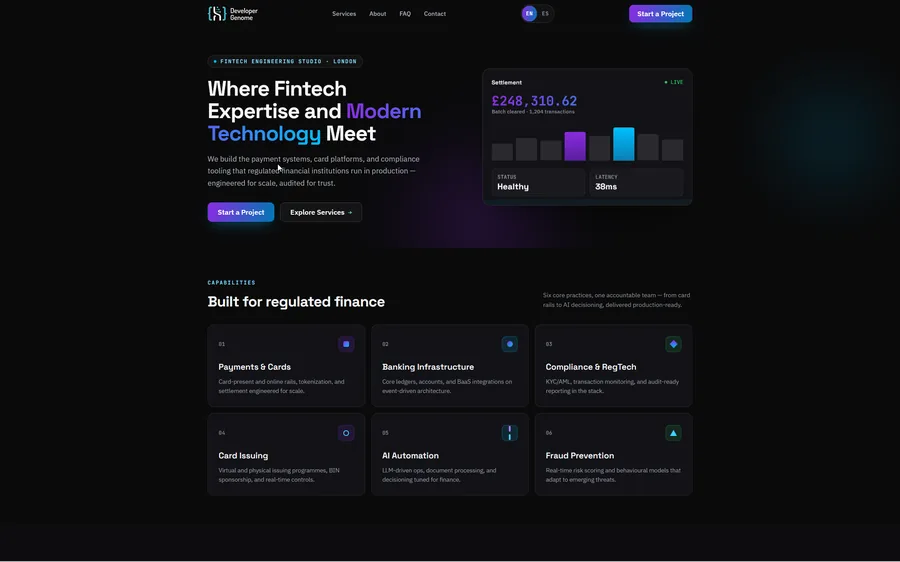
Developer Genome
One page → a ten-page bilingual site built to satisfy a payments underwriter.
- Web
- Hand-built
- EN + ES
- SEO
London fintech studio · ~8-request first load · 0 third-party calls · WCAG AA
Most redesigns quietly throw away the one asset the old site had actually earned. This one carries it across.
Start a project Book a 15-min intro call
A rebuild is the riskiest thing you can do to a site that already works. Not because the design is hard — because a site is a set of addresses that other people have written down, and a redesign changes all of them at once. Search engines, old emails, someone's bookmarks, a supplier's directory listing: they all point at the old shape.
Handled, that costs you nothing. Unhandled, you lose ground you spent years earning, and the new site gets blamed for it.
| What changes | What goes wrong when nobody plans it | The rule |
|---|---|---|
| Addresses | Old URLs stop resolving. Every link pointing at them — from a search result, from another company's site — lands on a 404. | every URL redirected |
| Titles & descriptions | Rewritten from scratch by whoever builds the new page, so the wording a page was found for quietly disappears. | carried across |
| Content | Pages that were doing real work get cut for looking dated. The ones that earn traffic are rarely the ones that look best. | audited, not guessed |
| Internal links | The pages you most want found lose the links that used to point at them, and drop out of sight from the inside. | mapped before the cut |
| The sitemap | Search engines keep crawling a map of a site that no longer exists, and take weeks to notice. | rebuilt, resubmitted |
None of this is exotic. It is just work that has to happen before the new design is signed off, not after it is live.
// how it carries across
The order matters more than any single step. Every one of these happens before the old site is switched off.
// what the new site inherits
The reason a rebuild here does not need an SEO retrofit afterwards is that there is nothing to retrofit. It is static, hand-authored HTML — the crawler and the visitor are served the identical thing.
// fit
The situations this is actually built for. If two or three of these land, we should talk.
And when it is the wrong call: if the site is honestly fine and the enquiries still are not coming, a redesign is an expensive way to avoid the real question. That is usually positioning, pricing, or that nobody knows the site exists — and none of the three is fixed by new typography. If that is what I find, I will say so, and you will not have spent anything to hear it.
Both are client engagements, both are written up end to end — the brief, the build, and what was actually delivered.
One page → a ten-page bilingual site built to satisfy a payments underwriter.
London fintech studio · ~8-request first load · 0 third-party calls · WCAG AA
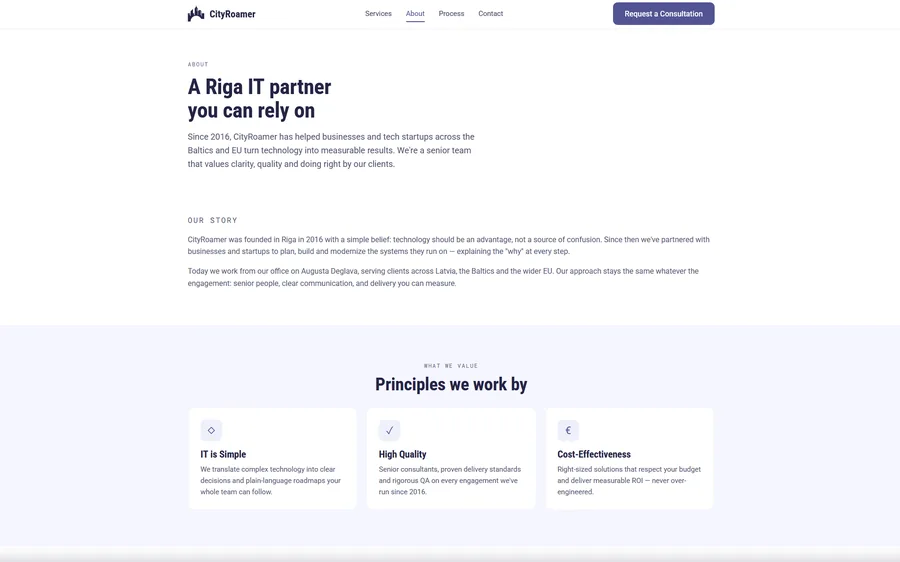
An ageing builder template → twelve hand-built pages they own outright.
Riga IT consultancy, senior since 2016 · 7 self-hosted fonts · 0 third-party calls
The same SEO-from-the-stack approach on a build of my own: a marketing site taken from no name to nine indexed pages inside a day.
“Ed rebuilt the site start to finish and handled the whole thing without fuss. Clean, fast, properly thought through — every page holds together and it works the way it should. What stood out was the handoff: a full interactive walkthrough of everything that was done, not the usual two-line email. Done well, done quickly. No complaints.”
“The new site looks and feels far more professional than the old one — clean design, nice touches throughout, and everything just works. Took care of it end to end and the quality shows. Very happy with it.”
// straight answers
Send me the address of the site you are thinking about replacing. I will tell you what is worth keeping.
As a guide, a credibility rebuild starts around €3,500 and a straight website build around €2,000. Every project is priced on its own complexity and the work actually in it. See the offers
Remote across the EU and UK, in English. Reply within one business day.
Start a project Book a 15-min intro call
Also on offer: custom software · working with London firms